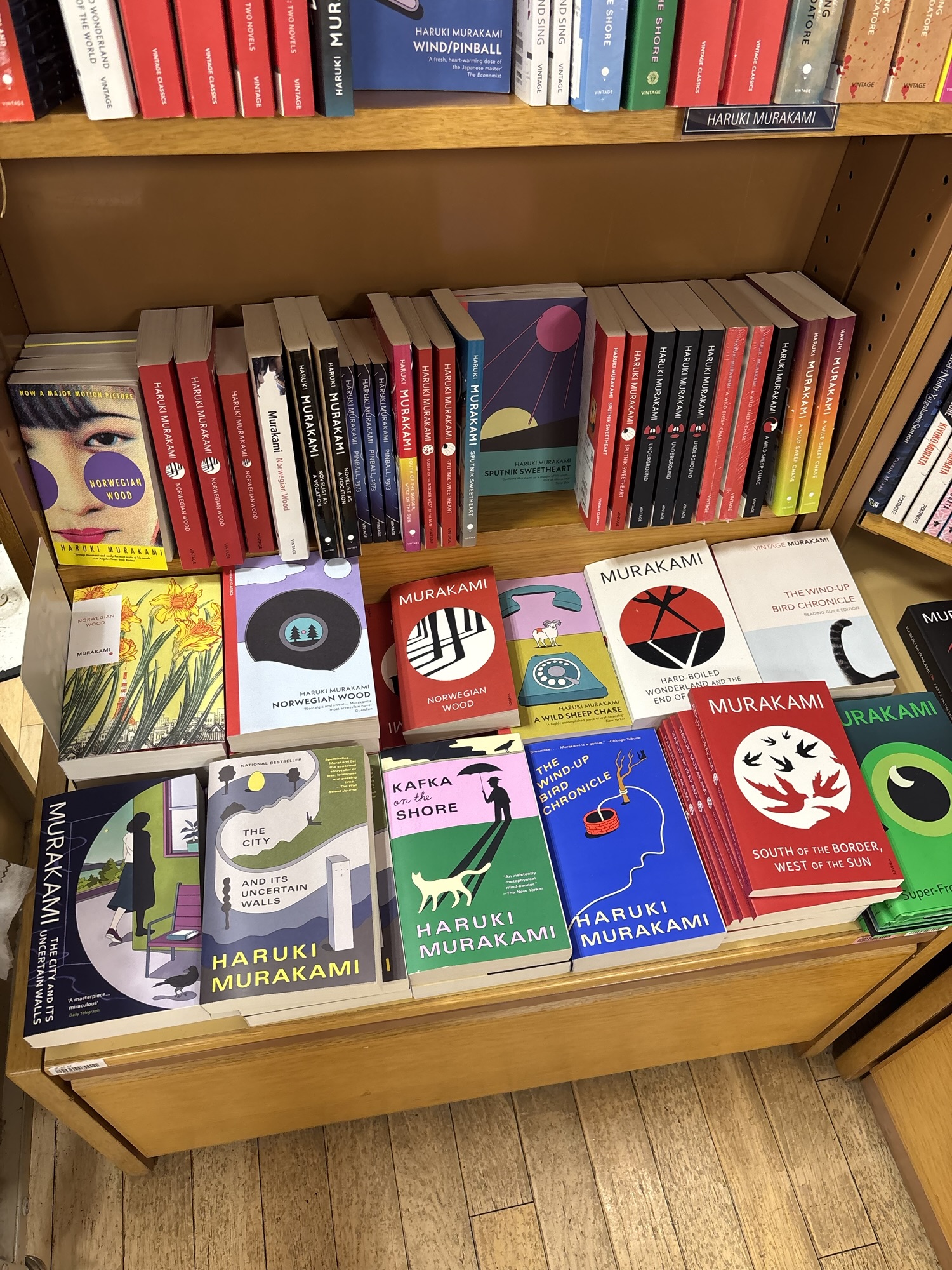
Haruki Murakami has written more than a dozen novels and a long shelf of short story collections, so “Which one should I read first?” is a fair question. The answer depends on what you want from a book. Start with the wrong one and you might bounce off a 900-page epic when a quiet love story would have hooked you for life.
This guide narrows it down. In short: start with Norwegian Wood if you want a realistic, emotional novel, Kafka on the Shore if you want the full strange Murakami experience, or The Elephant Vanishes if you would rather sample his style in short stories. Below you will find a quick chooser, a closer look at those three books, what to read next, and answers to the questions first-time readers ask most.
Murakami in 30 seconds
Murakami writes calm, clean prose about ordinary people: a bored office worker, a jazz-bar owner, a lonely student. Then their lives slip sideways. A cat disappears, a well appears, a stranger calls and says something that changes everything. Jazz records, home-cooked spaghetti, loneliness and lost people turn up again and again.
For a new reader, the useful thing to know is that his books come in two broad modes:
- Realistic: Norwegian Wood, Colorless Tsukuru Tazaki and His Years of Pilgrimage, and many of his short stories read like contemporary literary fiction.
- Surreal: Kafka on the Shore, The Wind-Up Bird Chronicle, Hard-Boiled Wonderland and the End of the World and 1Q84 mix the everyday with the impossible.
Pick the mode you are in the mood for, and you have already solved most of the problem. One warning: Murakami rarely explains every mystery. If you need all the threads tied up, expect to finish a few books with questions.
The three best books to start with
1. Norwegian Wood (the realistic love story)
Tōru Watanabe, a student in late-1960s Tokyo, looks back on his friendship with a fragile young woman named Naoko, and on his growing bond with the outgoing, unpredictable Midori. It is a coming-of-age story about love and grief, with no magic in it at all. Published in Japan in 1987, it made Murakami a household name there, and Jay Rubin’s English translation followed in 2000.
Why start here: it is the easiest way in if you normally read realistic fiction.
Keep in mind: it is the least typical of his major novels, and it deals with depression and suicide. If you read Kafka on the Shore next, expect a big change in tone.
2. Kafka on the Shore (the classic Murakami experience)
Fifteen-year-old Kafka Tamura runs away from home to escape a terrible prophecy. In a parallel thread, an elderly man named Nakata, who can talk to cats, sets out on a journey of his own. The two stories alternate, and the strangeness builds until they meet. Philip Gabriel translated it into English in 2005.
Why start here: it has the dreamlike logic, the missing people, the music and the quiet humor that define him.
Keep in mind: some scenes are sexual or disturbing, and the ending is open to interpretation.
3. The Elephant Vanishes (the short story sampler)
This collection of 17 stories includes “The Second Bakery Attack,” the title story about a missing elephant, and “Barn Burning,” which later inspired the film Burning (2018). The English translations are by Alfred Birnbaum and Jay Rubin.
Why start here: you can test his voice in an evening before committing to a long novel.
Alternative: After the Quake is a six-story collection set around the 1995 Kobe earthquake, and its stories share a more unified mood.
What to read next
Once you know which side of Murakami you like, here is where to go.
- If you loved Kafka on the Shore: try The Wind-Up Bird Chronicle or Hard-Boiled Wonderland and the End of the World. Both are surreal, layered and rewarding.
- If you loved Norwegian Wood: try Colorless Tsukuru Tazaki and His Years of Pilgrimage, South of the Border, West of the Sun or Sputnik Sweetheart. They are quieter and more realistic.
- If you want a long, immersive read: try 1Q84 (three books in one) or Killing Commendatore.
- If you prefer short fiction: try Men Without Women, which includes “Drive My Car,” the story behind the Oscar-winning film, or First Person Singular.
- If you want to know the author: What I Talk About When I Talk About Running is a short memoir about running, writing and discipline.
Do you need to read Murakami in order?
No. Most of his novels stand alone, and you can read them in any order.
The exception is his early run of books about a narrator and his friend known as the Rat: Hear the Wind Sing (his 1979 debut), Pinball, 1973, A Wild Sheep Chase and Dance Dance Dance. If you want to follow that thread, read them in that order. The first two were hard to find in English for years, until they were published together in one volume in 2015, translated by Ted Goossen.
A note on English translations
Most English readers meet Murakami through a small group of translators: Alfred Birnbaum, Jay Rubin, Philip Gabriel and Ted Goossen. Murakami is also a translator himself, and has put authors such as F. Scott Fitzgerald, Raymond Carver and J. D. Salinger into Japanese. Their influence shows in his smooth, conversational style, which tends to read naturally in English.
You do not need to choose a book by its translator. If you want to go deeper later, Jay Rubin’s Haruki Murakami and the Music of Words is a readable companion to the novels.
Frequently asked questions
Is Norwegian Wood a good first Murakami book?
Yes, if you like realistic fiction. It is easy to follow and emotionally direct. Just know that it is not typical of his stranger, more surreal novels.
Is Murakami hard to understand?
His sentences are simple and easy to read. What can feel hard is the meaning: events are often left unexplained, and that is part of the appeal.
Which Murakami book should I read if I only like realistic stories?
Try Norwegian Wood, Colorless Tsukuru Tazaki and His Years of Pilgrimage or the stories in Men Without Women.
Should I start with a novel or a short story collection?
If you are unsure about his style, start with a collection such as The Elephant Vanishes. If you already like long novels, go straight to Kafka on the Shore.
Final thoughts
There is no wrong way into Murakami, but there is a better way for you. For a realistic story, read Norwegian Wood. For the full surreal experience, read Kafka on the Shore. For a quick taste, read The Elephant Vanishes. Whichever you choose, give it a few chapters before deciding. His books tend to work slowly.
Have you read Murakami? Tell us which book you started with in the comments, and what you would recommend to a newcomer.